Skip to content
Hillside Farm Painting
Westport Historical Society
Westport, Massachusetts

Search Term Record

Metadata

Related Records

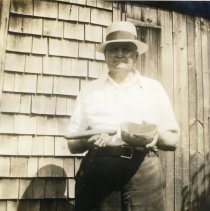
  1. Print, photographic
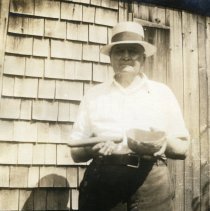
  2. Print, photographic
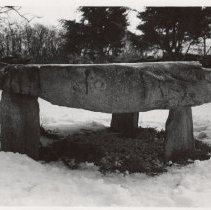
  3. Stonework/Arachaeological Site
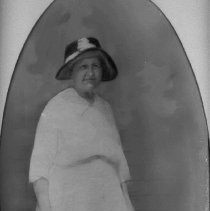
  4. Minnie Rose Stevens
  5. Indian Artifacts at Edward Kirby Farm/Drift Rd.
  6. 2009.035.001 - Index to Oral Histories Alton and Isabel Boan Interviewed by Mary Giles November 4th 1976 Subjects: Farming, Native Americans, Schools Etta Allen Palmer Interviewed by Mary Giles November 4th 1975 Subjects: Indian Burying Ground, Kate Cory, Farming, Lobstering Everett Coggeshall Interviewed by Mary Giles November 10th, 1976 Subjects: Westport Harbor, Hurricanes, Farms John Hart Interviewed by Mary Giles Undated Subjects: Grist Mill and Store, Ice Cutting Albert E. Lees, Jr. Interviewed by Mary Giles August 14th, 1975 Subjects: Schooling, Markets George Raposa Interviewed by Mary Giles May 14th, 1976 Subjects: Immigration, Farming, Market Gardening, Dirt Roads Andrew Borden's Farms Hartley Howe Interviewed by Mary Giles August 6th, 1973 Subjects: Cherry and Webb Point, Franklin Roosevelt, Cranberry Bog Borden R. Tripp Interviewed by Mary Giles October 7th, 1976 Subjects: Bojuma Farm, Adamsville Store, Notes: Opinions on Town Issues of the Day, Borden, Judy, Mary = Bojuma Eugene Feio Interviewed by Mary Giles November 19th, 1976 Subjects: Post Offices, Stage Coach Henry Sampson Interviewed by Mary Giles January 24th, 1976 Subjects: Potato Farming and Marketing Thomas P. Mead Interviewed by Mary Giles November 16th, 1976 Subjects: Photography Education Lincoln Tripp Interviewed by Mary Giles November 21st, 1976 Subjects: Tripp Ancestry, Historical Society Development Ideas, Cultural Development Ideas Helen E. Ellis and Rosamond Peirce Interviewed by Mary Giles September 15th, 1976 Subjects: Remodeling of Old House at Westport Point, Helen Ellis' Sculpture Emma Hart Widow of Boat Builder Fred Hart Interviewed by Mary Giles Fall, 1976 Subjects: Boats Built by Husband George Medeiros Interviewed by Mary Giles November 20th, 1976 Subjects: Dairy Farming, State Laws Relating to Land, Notes: Family History, Involvement in Numerous Organizations Janice Lawton Field Interviewed by Mary Giles October 4th, 1976 Subjects: Mayflower Ancestry, Antique Shop Notes: Interest in Historical Society and Possible Future Homes Milton Borden Interviewed by Anne Kennison June, 1976 Subjects: Tramps and Hoboes at Town Farm, Indians, Water Holes, Strawberry Farms, Family Activities Notes: Milton Borden grew up at the Town Farm Mabel Ball Crosby Interviewed by Mary Giles Undated Subjects: Oxen Incident; Shearing, Spinning, Weaving; 'Salat" Foods; Flowers and Herbs William H. Barker Interviewed by Mary Giles Undated Subjects: World War II Experience Notes: Concerns about Town Development, Town Meetings John Swartz Interviewed by Mary Giles September 19th, 1976 Subjects: "Village Commons" Rita and David Rozinha Interviewed by Anne Kennison May 14th, 1976 Subjects: Fishing, 1938 Hurricane Experience, Westport Point, Mill Ponds and Mills Herbert G. Hadfield Interviewed by Mary Giles March 21st, 1977 Subjects: Art/Scrimshaw, Town Landings Notes: Critical of new housing; fearful of overdevelopment, effects of Town Dump; Plans to Build Self-sustaining Home Mae Magee Holmes Interviewed by Mary Giles Undated Subjects: Dance, Teaching and Performing, Roger and Dorothy Acheson Interviewed by Mary Giles Undated Subjects: Painting,Dairy Farming Audrey Tripp Interviewed by Mary Giles Undated Subjects: Experiences in Westport School System Archer and Della Tripp Interviewed by Mary Giles October 5th, 1976 Subjects: Herring Run at Westport Harbor; Rum Running Arlene Gifford Interviewed by Mary Giles Fall, 1976 Subjects: Wolf Pit School, Music Teacher Notes: Bitter about Bicentennial Committee Benjamin Baker Interviewed by Mary Giles December 6th, 1976 Subjects: Variety of interests Notes: At interview time he was a student at Westport Middle School, a great nephew to Hartley Howe, age 13; concerned about too much building in town William Almy, Jr. Interviewed by Mary Giles October 25th, 1975 Subjects: Family Genealogy, Gooseberry Neck, Horse Breeding and Hunt, Description of House Notes: John James Audubon was family friend Etta Palmer and Mabel Crosby With Mary Giles (While riding along Drift and Main Roads) Subjects: Comments on various properties en route Norman H. Sasseville Interviewed by Mary Giles Undated Subjects: Conservation Commission, Town Meeting Government Gerald E. Miller Interviewed by Mary Giles Undated Subjects: Land Trust Julius T. Smith Interviewed by Mary Giles December 3rd, 1975 Subjects: Wildlife, birds, market gardening, Bell School events Notes: Mentions of Turtle Rock Farm and Sunnyside Farm, wages paid Mary Hix Brown and Durant Brown Interviewed by Mary Giles August 18th, 1975 Subjects: Families including Davis, Sowle, Allen, Russell, Earle, Waite, Hix, Hicks Notes: Also discusses rum distilleries and trade, slave cemeteries, whaleboat building, details of land divisions and early houses, mechanics of ferry operation Mary A. W. Sowle Interviewed by Mary Giles December 4th, 1975 Subjects: Local doctors, Westport Point Notes: John Babcock noted for building doll houses and furniture Richard Earle Interviewed by Mary Giles December 11th, 1975 Subjects: Fishing Notes: Greatly detailed information especially on lobstering and swordfishing; references to fishermen William White, James Hollis, Arthur Denault, and Raymond Davoll; Prelude Corporation Dorothy R.Gifford Interviewed by Mary Giles September 21st, 1976 Subjects: Westport Art Group, Personal History Notes: Discusses Norman Gifford, husband and educator Rev. Basil Hall Interviewed by Mary Giles August 19th, 1975 Subjects: Westport Point Notes: Describes New York to Fall River boat trips; purchase and building at the Point; defunct land promotion named Eldridge Heights Elizabeth Lees and Carlton Lees Interviewed by Mary Giles November 12th, 1976 Subjects: Westport Point Wharf, Public Service Career Notes: Names antecedents Cummings and Bowers; Sherman Family Cemetery Alice Blossom Interviewed by Dorothy Gifford Subjects: Blossom Road Area, Wampanoag Indians, Farm Life Notes: Mentions charcoal makers on Sanford Road, short train rides from Sanford Road to Beulah Road, a "boiling spring" on their farm Marion Reed Interviewed by Mary Giles November 11th, 1976 Subjects: North Westport, Indian Cemetery, Indian Perry Family, Notes: Much discussion of local Protestant churches and mergers Ann Baker - Architect Interviewed by Mary Giles November 15th, 1976 Subjects: James Tripp House, Building Moving Skills Notes: Discussion on loss of individuality as it affects building Practices Jones Shannon Interviewed by Mary Giles December 2nd, 1976 Subjects: Episcopal Church in a Barn on Main Road Daniel Meader Interviewed by Mary Giles October 29th, 1975 Subjects: Westport Harbor, Work on Building Charlton Estate Notes: Describes building stone walls; coal delivered by schooner to Adamsville Harold Wood Interviewed by Mary Giles November 17th, 1976 Subjects: Teaching School, Service as Selectman, Sewage Disposal Problem Alford Dyson Interviewed by Mary Giles November 14th, 1976 Subjects: Background in Mills and Unions Notes: Served on School Committee and as Selectman Charles Costa Interviewed by Mary Giles November 21st, 1976 Subjects: Dairy Farming, Avid Interest in Town Affairs, Service as Selectman and Board of Health Member Notes: During World War II high many High School boys served as volunteer firemen, it being understood that when the fire alarm sounded, they were immediately released from class to respond Allen G. (Bill) Tripp Interviewed by Mary Giles October 12th, 1976 Subjects: Development and Operation of Family Boat Building and Boat Yard Richard Paull Interviewed by Mary Giles October 14th, 1976 Subjects: Building of Family Home at Westport Point, Scout Master Experiences, Fishing for Oysters and Herring Notes: Reminiscences of Browns, Brownells and Potters Eleanor Tripp (Mrs. Louis H. Tripp) Interviewed by Mary Giles October 13th, 1976 Subjects: Purchase and Restoration of Handy House, Founding of Women's Club and Well Child Clinic Notes: Quotes records of Eli Handy, first Doctor Handy, 1764-1812 Eleanor Simmons (about Oscar Palmer) Interviewed by Mary Giles November 19th, 1976 Subjects: Registry of Voters and Assessor, Farming Notes: Attended Bell School Edward Yeomans Interviewed by Mary Giles November 13th, 1976 Subjects: Teaching, Peace Corps Notes: Considered responsible for bringing others to live at Westport Point: Tucker, Liepman, Adams, Harris, Ring, Kohlenberg, Deknatel, Trueblood, Rockwell William Pierce Interviewed by Mary Giles September 19th, 1976 Subjects: Farming Strawberries, Blueberries, Raspberries; Police Work, Major League Baseball

    Palmer Homestead Farming Native Americans Schools Hurricane gristmill Ice making Bojuma Farm Cranberries Boats Poor Farm Handy House Handy Hill

    Record Type: Archive

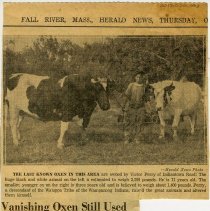
  7. Oxen still used on Farm
  8. 2023.023.001 - SOME NATIVE-AMERICAN AND AFRICAN-AMERICAN CONNECTIONS OF THE WAINER FAMILY Richard Gifford Draft of 02/12/2023 richard-gifford@cox.net GENEALOGICAL TABLES (SIMPLIFIED) --- Individuals with Biographical Entries in Boldface Type QUEBBIN-WAINER Dorcas (---) married Nathaniel QuebbinResided: Slocum's Neck, Dartmouth -Margaret Quebbin married (---) WainerResided: Division Road, Dartmouth --Michael Wainer (ca1748-1815) m. 3) at Dartmouth in 1772 Mary Slocum/Cuffe (1753-1804) --- Paul Wainer (1776-1833) m. Chloe (Dodge) Cuffe (ca1776-1862). Resided: Westport ----Asa F. Wainer (1813-1878) b. Westport, d. NB m. at Westport 1840 Mary Jeffrey (ca1820-1892) b. & d. NB ---John Wainer (1782-1869) m. 1) at Westport 1812 Avis Auker (1792-<1821); m. 2) at North Bridgewater in 1821 Mary Easton (1795-1872). Residence: Westport. John & Mary buried Beech Grove. ----David F. Wainer (1825-1910) b. & d. Westport m. at Dartmouth in 1850 Lydia Wainer (1828-1917) b. Stockbridge NY, d. NB, both buried Beech Grove. Residence: Slocum Road, Dartmouth. ---Michael Wainer [Jr] (1793-1876) b. Westport, d. Dartmouth, m. 1) in 1814 in Dartmouth Rhoby Auker (1793-<1838) b. Dartmouth, d. Stockbridge, NY ----Lydia Wainer (1828-1917) m. David F. Wainer as above . . . m. 4) at Westport in 1806 Mary (Amos) White (ca1771-1827) --- Rodney Wainer (ca1809-1868) b.& d. Westport. MINGO-EASTON (---) Mingo m. Richard Gonduary (=Quanneway?) -Mercy Gunway (=Quanneway?) of Little Compton m. at LC 1736 Caesar Easton. Resided: Titticut Reservation, Middleborough. --Moses Easton (b.ca.1748) Forge smith, m. at Norton, MA 1769 Rosanna Prince. Resided: Westport, Dartmouth, New Bedford. --- Rev. Peter Easton (1787-1824) Minister, m. at Westport 1819 Rhoda Cuffe; buried Beech Grove, Westport. Resided: Hartford, CT; Dartmouth. Pastor, Talcott Street Congregational Church, Hartford 1821-23. ---Charles Easton (b.ca1800) m. at NYC? Sally BoothResided NYC & New Bedford ----Charles F. Easton (1824-1906) b. NYC d. Fall River m. Marie Antoinette Leggett -----William Edgar Easton (1861-1935) Playwright, author of Dessalines (1892) and Christophe (1903), b. NYC, d. Los Angeles, CA. Resided New Bedford; Austin, TX; Los Angeles, m. at Travis Co, TX in 1888 Mary Elizabeth Thornton --James Easton (1754-1830) Foundry and forge owner, d. North Bridgewater (Brockton), buried Melrose Cemetery, Brockton, m. Sarah Dunbar (1756-1833) ---Sarah A. Easton (1789-1837) b. North Bridgewater, d. Boston, buried Melrose Cemetery, Brockton, m. Robert Roberts (1781-1860) b. Charleston, SC, d. Boston, buried Woodlawn Cemetery, Everett, MA; author, The House Servants' Directory (1827) --- Benjamin Franklin Roberts (1815-1881) m. Adeline Fowler, resided Boston, Chelsea, Lynn, buried Mt. Auburn Cemetery, Cambridge. Author, Report of the Colored People of the City of Boston on the Subject of Exclusive Schools. Publisher, The Anti-Slavery Herald; publisher, The Self-Elevator. Printer, book publisher, activist. ----Sarah Roberts (b.1843). Named plaintiff, Roberts v. City of Boston (1848), establishing "separate but equal" doctrine in school desegregation cases, cited as authority by US. Supreme Court in Plessy v. Ferguson (1896); overruled in Brown v. Board of Education (1954). --- Mary Easton (1795-1872) m. John Wainer as above ---Rev. Hosea Easton (1799-1837) Author, Address to the Coloured People of Providence, Rhode Island on Thanksgiving Day (1829); author, A Treatise on the Intellectual Character and the Civil and Political Condition of the Colored People of the United States (1837); lecturer, activist, minister, b. North Bridgewater, d. Hartford, CT; buried Old North Cemetery, Hartford; pastor, Talcott Street Congregational Church, Hartford (1831-1836); pastor, Colored Methodist Episcopal Zion Church, Hartford (1836). ----Sampson Easton (b.ca1830) m. Louisa (---). Proprietor, Easton Academy of Music, Hartford. -----Hosea Easton (1851-1899) Musician, comedian. Resided in Sydney, Australia. Buried in Waverly Cemetery, Sydney. QUANIWELL -?Quonowin1674 seller, with "squaw sachem" Wetamo and others, of land near Taunton River --?John Quannua1706 purchaser of two 20 acre tracts of undivided Dartmouth land --- Peter Quaniwell (ca1735->1795) b. Tiverton?; d. Dartmouth; m 1) at Tiverton in 1760 (as Peter Quaneway) Mary Ephraim; m. 2) at Dartmouth in 1793 Martha Job. ----Joseph Quaniwell (ca1763-1834) b. Dartmouth; d. New Bedford, m. at Dartmouth in 1788 (as Joseph Quannawin) Hannah (Richmond) Peckham (ca1759-1834) b. Dighton or Westport, d. New Bedford -----Pamelia Quaniwell (ca1790->1821) m. Simeon Jeffrey (ca1790-1821) ------Mary Jeffrey m. Asa F. Wainer as above JEFFREY-SIMON -?Jeffrey 1674 signer, with Mainokum and other "Indians of Dartmouth" pledging loyalty to Plymouth Colony --Joseph Jeffrey (ca1725-ca1760) d. at sea, m. at Acoaxet ca1750 by John Simon, Indian minister to Amy Hinckley (ca1730->1811), b. Acoaxet. Resided: Clark's Point, New Bedford. --- Thomas Jeffrey b. New Bedford, m. at Dartmouth in 1769 Deborah Simon, b. Acoaxet? ---- Simeon Jeffrey m. Pamelia Quaniwell as above --- Mary Jeffrey m. Asa F. Wainer as above AMOS Amos Listed as indentured servant in estate of Edward Richmond of Little Compton (1696); devisee of one half of 16 acre lot at Acoaxet under the will of Joseph Church of LC (1712) --Amos Amos Bound out to John Gifford of LC (1757). m. at Tiverton Congregational Church in 1764 Rebecca Hinckley, b. Acoaxet ---Mary Amos (ca1771-1827) m. 1) at Westport in 1792 Joseph White; m. 2) at Westport in 1806 Michael Wainer BIOGRAPHICAL James Easton (1754-1830) Sarah Dunbar (1756-1833) Parents of Mary (Easton) Wainer James Easton probably grew up on the Titticut Reservation (in Middleborough), where his father was involved in several land transactions. James Easton first appears in the records as a soldier in the American Revolution in 1776, constructing the fortifications on Dorchester Heights, under the supervision of Gen. Washington. Easton's future father-in-law, Sampson Dunbar, was involved in the same activity. After the withdrawal of the British from Boston, Easton was reassigned to the company of Capt. James Allen in Col. Simeon Cary's regiment, this unit assigned to defend upstate New York in 1777 against the invasion forces of Gen. John "Gentleman Johnny" Burgoyne, which were attacking southward along the west shore of Lake Champlain with the ultimate intention of linking up with Gen. Clinton's forces, then ensconced in New York City, thus splitting New England off from the remainder of the rebelling colonies. James Easton was reported killed in action in the regimental return on July 6, 1777, but fortunately this was not the case. There was only one action taking place on the day of Easton's reported death, the capture of Ft. Ticonderoga by the British. The reason why the regiment considered him dead may be gleaned from the account provided by William Cooper Nell, the nation's first professional African-American historian, in his Colored Portraits of the American Revolution. Facing overwhelming numbers, the Americans had decided to abandon Ft. Ticonderoga. But in order to delay a close pursuit by the British of the retreating American column --- burdened with stores, ammunition and the fort's cannon --- which might result in a disaster, the Americans decided to deceive the British by leaving a force of just four men inside the fort, with but a single instruction: fire the one remaining cannon on the approach of the British to make them think that the fort was still occupied. For this suicide mission one man was selected by lot from each of the regiment's four companies, and one of the unlucky four was James Easton. Historian John C. Miller gave an account of what happened next: The rebels made good their getaway, all the British saw of the garrison was a cloud of dust kicked up by the fleeing Americans. Guns, cannon, ammunition and provisions they found in plenty, but of rebels none but four soldiers who had been left behind to fire a large cannon at the British when they came within range. But even this suicide squad was found dead drunk by a cask of Madeira. That Easton and his companions were more interested in the Madeira than the cannon may have a wise choice, for if the British would have been fired upon they may have killed the tiny garrison. As it was, Easton would have numbered among the 228 prisoners reported captured by the British for the entire engagement, and probably endured prolonged imprisonment, as the next record of him anywhere does not appear until more than three years later, when he was admitted as a member of the Church of Christ of North Bridgewater . Some time after the war Easton took up the trade of blacksmithing, assisted eventually by four of his sons. William Cooper Nell (whose father was involved with James' son James Jr and son-in-law Robert Roberts in various Boston anti-slavery societies of the 1830s) gives an account of Easton's business activities in these years. Mr. Easton was a manufacturing blacksmith, and his forge and nail factory, where he also made edge tools and anchors, was extensively known for its superiority of workmanship. Much of the iron work for the Tremont Theatre and Boston Marine Railway was executed under his supervision. Mr. Easton was self-educated. . .and was welcome in the business circles of Boston as a man of strict integrity, and the many who resorted to him for advice in complicated matters styled him "the Black Lawyer." In March 1801 Easton was one of four men appointed "Culler of Hoops and Staves" for the City of Boston, in which capacity he certified the work of Boston's blacksmiths. As Price points out: Any person chosen for such an important city position would have to be generally recognized as an expert in their field and for a man of color to receive such an appointment during that era -- - in spite of customary prejudice and discriminatory treatment --- would indicate that he possessed a more remarkable expertise than normal. By 1814 Easton had constructed a foundry, at which time his land holdings were at 54 acres. In October 1816 James Easton Jr., having "just returned" from a weeklong stay with the Cuffe and Wainer families in Westport, wrote to Paul Cuffe requesting a $1000 loan, to be secured by Easton real estate, in order to establish an "institution" for educating workers at the Easton forge/foundry complex. While there is no recorded reply from Cuffe, less than two months later a mortgage was given to Samuel Rodman (brother-in-law of William Rotch Jr) in the amount of $2000. The Eastons established a sort of factory school which combined training in vocational trades with academic study. Among the alumni of this school were James Easton's nephew Benjamin F. Roberts and the Boston civil rights activist and author Robert Benjamin Lewis. While Easton's forays into the white business world were, at least at first, reasonably successful, his relationships in practicing his religion met with resistance. In 1780 Easton had been accepted into membership in the Church of Christ of North Bridgewater, but problems arose when in 1789 the church was rebuilt, the new building containing a "Negro porch" where people of color were supposed to sit. Easton had paid a rental for his family's pew on the main floor, but after the redesign pressure was put on him to forfeit his pew and sit with the other people of color. This Easton refused to do, and he arrived one Sunday to find his pew coated with tar. The next Sunday Easton arrived at the church with a wagon full of seats for his family --- removing the tar-coated pew, they sat in the seats they brought with them in the aisle space. Price regards this act as the first "sit-in" protest by people of color in American history. Hostility towards the Easton family continued, resulting in their joining the Baptist Church in Stoughton, but even there problems arose, and by the time of his death James Easton appears not to have been a member there, and shortly after James' death his wife was removed from the membership rolls. A factor which might explain some of the hostility occurred in 1818, when James' son Caleb Easton married Chloe Packard, who at the time was 4-5 months pregnant. Chloe was the daughter of one of the town's prominent white families, and this marriage may have proved a bridge too far in testing the townsfolk's appetite for assimilation with the Eastons. Caesar Easton Mercy Gunway (=Quanneway?) Paternal grandparents of Mary (Easton) Wainer Caesar Easton was either a freed slave of the Easton family of Newport or the son of a freed slave of the Eastons. Rev. Hosea Easton wrote that he was "of the third generation removed from slavery," which would indicate that Caesar was not born into slavery. The Eastons were one of the original families settling Newport : both Easton's Beach and Easton's Point are named for this family. Nicholas Easton served as President (i.e. governor) of Rhode Island Colony from 1650-54 and as Governor from 1672-74. His son John Easton served as governor and his son Peter Easton was treasurer. The Eastons had converted to Quakerism in the 1660s, and by 1701 the last of the Easton's slaves had been manumitted. In 1736 one Caesar Easton "of Rhode Island" [i.e. Aquidneck Island] crossed the Sakonnet River to marry Mercy Gunway "of Little Compton" in the bride's hometown. The surname Gunway is problemetic, as no other person with such a surname appears in any area town. Perhaps the surname is a variant spelling of Quanneway, a family appearing in several Tiverton records of the mid-1700s, as will be discussed further in connection with the ancestry of Mary (Jeffrey) Wainer. By 1748 Caesar Easton was living at the Titticut Reservation, where he purchased 90 acres from his in-laws, Richard & Mingo "Gundoury," with Richard listed as "Negro" and Mingo as "Indian." An additional purchase at Titticut was from four Indians, among them John Simon, who later appears as an "Indian justice" and minister at Acoaxet. By the late 1700s the sons of Caesar Easton had dispersed to the towns of Taunton, North Bridgewater and Westport. Rev. Hosea Easton (1799-1837) Brother of Mary (Easton) Wainer Rev. Hosea Easton was a minister, lecturer and author, his major work being A Treatise on the Intellectual Character and the Civil and Political Condition of the Colored People of the United States, published shortly before his death. By the time of his death he was the most influential African-American abolitionist in the country, but within ten years the abolitionist movement had changed course, leaving Easton largely forgotten and a mere footnote in abolitionist history. Easton moved to Boston to study for the ministry, but his first pastorate was at the Talcott Street Congregational Church in Hartford, the first black church in that area. Its first pastor had been Paul Cuffe's son-in-law (and Hosea's first cousin) Rev. Peter Easton, who served from 1821 to 1823. The church had been founded, as had many of the first wave of black churches throughout New England, because blacks were unable to enjoy the benefits of full participation in the existing churches. In the basement of the church Hosea started the first school for black children to be established in Hartford. Hosea Easton's pastorate was anything but untroubled. Two race riots, one lasting four days and both stemming from incidents outside the church, took place in 1834-35, and the homes of several nearby church members were burned down. In 1836 Rev. Easton built a new church, the Colored Methodist Episcopal Zion Church on Elm Street, but this church was burned down in another act of arson. It is against this background of personal experience that Easton's writing should be understood. He was an abolitionist in the traditional sense, but for him the problem was much wider. The North was, by this time, relatively free of slavery, but the problem of racial prejudice persisted in its absence. Without attacking the underlying problem of prejudice, the elimination of slavery throughout the land would provide only partial relief. One of Easton's chief villains was the American Colonization Society, which he saw as sustaining the slave system that its leadership (including Madison, the first ACS president) claimed it was trying to end. In his Address to the Coloured Population of Providence, Rhode Island on Thanksgiving Day (1829) he condemned the ACS' . . .diabolical pursuit where they will steal the sons of Africa, bring them to America, keep them in bondage for centuries, then transport them back to Africa by which means America gets all her drudgery done at little expense. Another of Easton's targets were the northern abolitionists who would shed crocodile tears for the oppression of blacks who lived a thousand miles away in slavery, but too often turned a blind eye to the oppression of blacks in their own communities. For Easton, one did not have to "look away down South in Dixie," as the song goes, to see racism, he could see it from his front window. The fate of the two black populations were uncoupled: the elimination of slavery in the South would not mean the elimination of prejudice in the North, and the most likely result of emancipation would be that prejudice would replace slavery in the South and thus would reign supreme throughout the land. And it would be hard to argue with Easton that, as history unfolded in the decades after his death, through Reconstruction and beyond, this is exactly what happened. Moreover, the abolition of slavery would by itself be only the first step, hinting at what in modern discourse we would call "reparations": . . .emancipation embraces that the emancipated must be place back where slavery found them, and restore to them all that slavery has taken away from them. Merely to cease beating the colored people, and leave them in their gore, and call it emancipation, is nonsense. Nothing short of an entire reversal of the slave system in theory and practice --- in general and in particular --- will ever accomplish the work of redeeming the colored people of the country from their present condition. Easton's view may seem obvious today, but it was not widely held in his time, either among white or black abolitionists. More representative was the view expressed in 1870 by his brother-in-law Benjamin F. Roberts (whose role as the leading figure in ending segregation in Boston's schools will be discussed in another installment), like many others still dizzy with post-Juneteenth euphoria, but who in more sober times had been the publisher of two Boston abolitionist newspapers: The new era to the black man places him on an equal footing with all other men in this country. As liberty, equality and fraternity are not now limited to color or previous condition, the great avenue to success is open, and the prosperous future depends on the proper exertion of all people to merit their share in the general distribution of all mental, physical and moral business resources. It is "the good time to come." We must improve it, if we are not to be left in the rear. Sympathy, after this, for anyone on account of color, will be a thing of the past. Every man must now figure for himself. Hosea Easton died at age 38 of unknown causes. In his Treatise, published shortly before his death, he may have touched upon one cause: The effect of these discouragements are everywhere manifest among the colored people. I will venture to say, from my own experience and observation, that hundreds of them come to an untimely grave, by no other disease than . . .oppression. William Edgar Easton (1861-1935) First cousin twice-removed to Mary (Easton) Wainer A great-grandson of James Easton's brother Moses, William Edgar Easton was born in New York City but spent much of his early life in New Bedford. His own life story seems sufficiently exotic to have formed the basis for one of his plays. His mother was Marie Antoinette Leggett, born in New Orleans to a Creole family having ancestral roots in Haiti. He grew up in a household where both French and English were spoken. His father, Charles F. Easton, was a barber in New Bedford. William's mother died when he was 14, and care of his education was assumed by a mysterious "godmother," a certain Baroness de Hoffman. William was educated at LaSalle Academy in Providence, the Seminaire St. Joseph de Trois-Rivieres, Quebec and at the College de St. Croix in St. Cesaire, Quebec. Easton went from Canada to Austin, TX in the early 1880s, where he married and became an organizer and speech writer for the Republican Party (his father-in-law was active in Texas Republican politics and held several local offices). By 1901 Easton relocated to Los Angeles, where he lived the remainder of his life. He held a variety of clerical jobs and also wrote speeches for the Republican and Progressive Parties, and he seems to have prospered. In a 1930 interview in the NAACP magazine The Crisis, Easton made a few references to his more remote ancestry, claiming that he was descended from James Easton of Revolutionary War fame, but it is clear that he was in fact descended from James' brother Moses . Easton also dropped the name of Capt. Paul Cuffe several times, in such a way as to suggest a descent from his as well (through Rev. Peter Easton, presumably, whose children by Rhoda would indeed be Paul Cuffe descendants). Rev. Peter Easton's own ancestry is uncertain to some extent, as no birth record can be found, but it would appear that Peter Easton was a great-uncle of the playwright, a brother of William's grandfather Charles Easton. Until William Easton's time (and continuing, in point of fact, well after his time) the portrayal of blacks on the stage, or in songs or literature, consisted of simple-minded, buffoonish characters acting out in clownish fashion an assortment of negative racial stereotypes. William Edgar Easton set out determined to change the depiction of blacks on the American stage, and his main characters would be heroic figures. Written in blank verse, his two plays share other characteristics of Shakespearean drama (including playing fast and loose with historical fact in order to heighten dramatic impact). His first play, Dessalines, debuted in 1893 in Chicago . Co-starring Henrietta Vinton Davis, the foremost African-American actress of her time, the play depicted the life of Gen. Jean Jacques Dessalines, who led Haitian revolutionary forces to victory after the imprisonment of Touissant L'Ouverture. In his preface to Dessalines, Easton himself gives the best explanation of what he hoped to accomplish: The Negro alone fails to immortalize his distinguished dead, and leaves to the prejudiced pen of other races the office, by which a proper conception of duty to posterity, very properly becomes his duty. Indeed we have excellent caricatures of the Negro in his only recognized school of legitimate drama, i.e. buffoonery. But the author of this work hopes to see a happier era inaugurated by the constant production of legitimate drama, written exclusively for Negro players and meeting, he hopes, with the full endorsement of the brother in white. Othello, once the pride of the ambitious colored histrionic, has sadly metamorphosed his once singularly dark complexion and now holds the boards the victim of a very mild case of sunburn. Easton's second play, Christophe, was based on the life of Henri Christophe, Haiti's second ruler. Christophe (paralleling Shakespeare's Henry IV) had attained power by deposing his predecessor and former ally, Dessalines. Supposedly written with Henrietta Vinton Davis in mind, the actress again co-starred in the 1911 debut of Christophe at the Lenox Casino in Harlem. Hosea Easton (1849-1899)Great-nephew of Mary (Easton) Wainer Grandson of Rev. Hosea Easton, Hosea grew up in Harford, where his father, Sampson Easton owned The Easton Academy of Music on Commerce St., where he made and repaired banjos, fiddles and other instruments. The Hartford Courant reported an incident in 1861 when "Sam" Easton rescued a woman who had fallen into the nearby Connecticut River. Braving the icy waters, Easton rescued the woman and carried her to the river's bank. Upon regaining her composure, the woman stared at her rescuer then, realizing his race, rewarded him with a slap across the face. A banjo prodigy, Hosea Easton joined the Original Georgia Minstrels. Unlike most minstrel groups, who were white men performing in blackface, the Original Georgia Minstrels were black men. No less a contemporary authority on political correctness than William Lloyd Garrison gave his seal of approval to the group (the dour Garrison didn't say he enjoyed the music or humor, but he did assure readers that the performance contained no offensive material). His musical numbers interlaced with comedic patter, Easton accompanied the group on an international tour to China, Hong Kong, Australia and New Zealand. The Sydney Mail reported that Easton "draws considerably on theology and temperance for his witticisms." The Daily Telegraph called him "one of the cleverest and most versatile colored comedians we have ever had in this country." Easton was so impressed with Australia that he decided to make Sydney his permanent home. He branched out into "serious" acting, with a 1924 account from the Adelaide Sport stating The original "Uncle Tom" in Uncle Tom's Cabin was the famous Hosea Easton, when Douglas was Simon Lagree and Belle Douglas (who years afterward married Jack Parsons) played Little Eva, who was taken from her death bed by the angels. Hosea was great in the old man parts and met for years with much success in all the States. Easton became a celebrity in his adopted country --- even when arrested for assault, the newspaper account referred to him as "the famous banjo player, Hosea Easton." His funeral in Sydney was attended by 2000 people, and accounts of the funeral procession from the church to Waverly Cemetery, accompanied by his musician friends, seem to depict what we would recognize as a New Orleans style "jazz funeral." Margaret Quebbin Dorcas Quebbin Mother and maternal grandmother of Michael Wainer In the 1859 Wainer land claims case, John Wainer testified I remember my grandmother. Her name was Margaret Quebbin. She was a full-blooded Indian. She lived part of the time in Dartmouth and part of the time in Westport. She lived about one and half mile west of Slocumb's River, near where Naomi Quance lived. My great-grandmother was Dorcas Quebbin, she was reputed to have lived down by Slocumb's. The earlier ancestry of this line of the Quebbin family is clouded. One intriguing possibility is connection to Peter Quakin a/k/a Osomehow, the brother of Mamanuah, the Acoaxet sachem at the end of the 1600s. There are numerous variants of this surname (Quaquin, Kewaquin, etc) but in several land records the surname was spelled Quabin and Cuabin, which phonetically is very close to Quebbin. In the earliest deed where Michael Wainer purchased property, he was called "Michael Wainer of Dartmouth, mustee man alias Michael Quaben." One other set of circumstances should be taken into account. In the Wainer land claims case presented to the Massachusetts legislature in 1859, the claimants (Rodney Wainer, Asa Wainer and unspecified others) claimed ownership of eight specific farms, in whole or in part. The four Dartmouth farms (John Wing, Samuel Brightman , Otis Slocum and Samuel Barker) were claimed on the basis that Wainer ancestors had occupied these lands over an unspecified length of time. The four "Westport" farms were claimed on a different basis: in addition to possession, the Wainer ancestors had once held deeds to these Westport properties, and these properties "had never been sold, transferred or alienated." Unfortunately there is no indication in the surviving record that any such deeds were introduced into evidence, nor is any mention of such deeds made in the arguments that were recorded. Since the names of the Wainer ancestors who held these deeds are not given, we would seem to be at a dead end at determining who they were. But if we had a list of all Indian grantees of Acoaxet lands, then somewhere on that list must be at least one Wainer ancestor. The list of Indian grantors and grantees of Acoaxet is a limited one, and if the Wainer claims had merit then at least one of the grantees must be a Wainer ancestor. The list is as follows: Peter Quakin/Kewaquin/Queaquin etc a/k/a Osomehow/Osomehue. Brother to Mamanuah. Signer of 1674 agreement, with brother Pasotoquo, acknowledging their brother Mamamnuah to be "sachem and chief proprietor of Sakonnet lands." (This agreement is filed in Bristol County Deeds/Fall River). Not listed as a grantee in the indices, he is the grantor in a number of deeds to white settlers. His land was in the area north and east of Quicksand Pond, much of it within Little Compton. Peter or his son Pope Quakin a/k/a Pope Idiohe sold parcels to white settlers Thomas Butts , Henry Head and John Wilbore. It is possible that Peter Quakin somehow received his land from "Stephen the Indian," as the land appears to be in the same area but no Stephen is listed anywhere as a grantee or grantor. Alderman: The Indian who shot King Philip. Col. Benjamin Church wrote that as a reward for his actions, he was given King Philip's severed right hand, which was marked by a scar where a gun Philip had shot misfired (a common occurrence in the days of the flintlock). According to Church, Alderman preserved the hand in a pail of rum and after the war carried it around to taverns, where in exchange for a penny he would display it to the curious. In 1685 Mamanuah deeded to Alderman, who then resided at Nonquit, a 100 acre parcel, bordering the WLCT/St. Vincent de Paul property on the Little Compton side. John MamamuahSon of Mamanuah; grantee from Mamanuah.. William/Will MamanuahSon of Mamanuah; grantee from Mamanuah. HowdeeGrantee from Mamanuah. In the Wainer land claims case Charles Manchester, who lived on Old Harbor Road, testified that until the 1830s an Indian named Jacob Howdy lived along the west side of the West Branch, about one mile north of the Abraham Manchester farm (south end of Old Harbor Road), which would be in the approximate area in Acoaxet of the 30 acres conveyed to Howdee. In 1829 the New Bedford Mercury noted the death of Sarah Howdee of Little Compton, "the last of the Sakonnet tribe" Isaac the Indian Preacher: grantee from Mamanuah. A one third interest in his 40 acres appears to be conveyed in the 1740s by one Isaac Crocker, "Indian man of Little Compton" to Perez Richmond. As noted below, testimony in the 1813 case of Dartmouth v. Westport from Charlotte White's mother would indicate that Isaac the Indian Preacher's grandson was Joseph Jeffrey. Stephen the Indian a/k/a Nocanow : Not listed in deeds as a grantee, but listed as an abutter to the properties of John Mamanuah. The area between Cockeast and Quicksand Ponds was referred to both by its "English name," Stephen's Neck, and by its "Indian name," Newtinnick . Since Stephen the Indian's land is shown by land records to have been located between Quicksand and Cockeast Ponds, it would be a fair assumption that Stephen's Neck was named for him. Stephen was reputed to be a brother of Mamanuah. If that is true, then Peter Quakin a/k/a Osomehow would also have been a brother and he may have inherited or acquired the land of Stephen, who is not listed in any deeds as grantor. In 1673, Steven alias Nucano and Wittamo [Weetamoo] witnessed a deed executed by Tatamonock, Ben alias Petononowet , and William alias Ijasack to Hugh Cole of Swansea for land along the Taunton River, partly bounded by a "Great pond" called Wattupogue [Watuppa]. Jonatus, Sam Parackus, Sue Codimonk (sister of Jonatus): Perhaps heirs of Stephen the Indian, these three sold land in 1696 located between Cocoest (Cockeast Pond) and Nanoquachings (Richmond Pond). An intriguing entry in Dartmouth Vital Records is the 1773 marriage of Margreat Waner, Indian to Newport Gardner, Negro man. The possibility exists that the groom is Newport Gardner a/k/a Occramer Marycoo (1746-1826), who arrived in Newport as a slave in 1760. Gardner founded the Free African Union Society in 1780, the first association started by Africans in America. Proprietor of a music school in Newport, in 1802 he became America's first published African-American composer, of the song "Crooked Shanks." He died in Liberia in 1826, leading a group of 31 African-Americans who planned to establish a colony there. That Newport Gardner in Dartmouth is the same one is an open question. The Newport resident is known to have had a wife named Limas, but there is no marriage record to Limas, and the 1783 birth of their eldest child Silva Gardner (1783-84) does not preclude an earlier marriage to a different wife. It seems likely that, whoever the groom was, this Margreat Waner would have been a daughter of Margaret Quebbin and a sister of Michael Wainer, the latter's own first marriage (to Deborah Pequit) taking place in Dartmouth in 1769, making Michael a contemporary of Margreat (Waner) Gardner. Michel Wainer gave the name Gardner Wainer to one of his sons in honor of this relative. Another entry in Dartmouth Vital Records merits attention, the 1795 marriage of Sarah Wayner to Pero Russell, "black people." Russell is said to have operated a "restaurant" somewhere in Dartmouth where diners enjoyed his house special, roasted skunk. He is perhaps the ancestor of the Pero family of Westport, although other possible ancestors (e.g. Pero Howland, Pero Coggeshall) exist. The 1795 marriage year of Sarah seems to make more likely the prospect that she was the daughter of Michael Wainer than of Margaret Quebbin. Mary Amos (ca1771-1827) Last wife of Michael Wainer, mother of Rodney Wainer. Likely the daughter of Amos Amos, who first appears in Little Compton records in 1757, bound out to John Gifford, who lived on John Dyer Road west of the area of Meeting House Meadow and the Jehu burial site mentioned below. In March 1764 Amos "Ammons" and Rebecca "Hinely" were married at Tiverton Congregational Church; the prior month marriage intentions had been issued in Dartmouth to Amos Amos and Rebecca Hinckley , both "Indians." An anonymous Nantucket merchant account ledger from 1764-65 mentions Joseph Salisbury of Dartmouth and his Indians Isaac Monet and Amos Amos. The father of Amos Amos may have been the servant mentioned in the 1711 will of Joseph Church of Little Compton, brother of Col. Benjamin Church, who devised "to my Indian boy Amos one half of a 16 acre lot at Coakset." The 1696 inventory of the estate of Edward Richmond, a neighbor of Church, lists Indian servants Peter Awashonks , John Ahamo and Amos, the remaining time on their indentures valued at 3 pounds each. The father of Rebecca Hinckley was probably Daniel Hinckley, "an Indian who became an effective preacher of Christianity and teacher at Coaxset." In 1698 Revs. Grindall Rawson and Samuel Danforth, representing an English missionary society, conducted a survey of Christianized Indians, visiting both the Sakonnet village and the Acoaxet village: At Cokesit in Little Compton, Daniel Hinckley hath taught here four years, twice every sabbath. Eleven families are his auditors; most of the men can read, and many young ones. . . can say their catechisms. Of this number, three persons are in full communion with the church settled at Nukkehummes [Dartmouth] . A person called Aham is schoolmaster here, and we are informed performs his work well. Here are also two persons improved as rulers. Preaching here, the two forementioned teachers, at our direction, prayed very soberly and understandingly. In 1792 Mary Amos married at Westport Joseph White , a brother of Charlotte and brother-in-law of Paul Cuffe's brother John. By this marriage she appears to have had two daughters, including Hannah White who married Peter Quaniwell, "people of color," in Westport in 1810. Peter Quaniwell sold a 10 acre parcel on the north side of Adamsville Road in the area opposite the Cornell Road intersection to John Cory , including a shoemaker's shop and a house "which I have built and now occupy." Peter Quaniwell died at the notorious Dartmoor Prison in England in 1815, where he was held after being seized during the War of 1812 from the Dartmouth merchant shop Walker. Peter Quaniwell was the uncle of Pamelia (Quaniwell) Jeffrey (ca1790-<1821), wife of Simeon Jeffrey of New Bedford, who were the parents of Mary (Jeffrey) Wainer (1819-1887), wife of Asa F. Wainer, a woman whose prolific Native-American ancestry as will be discussed further. Mary White was "of Little Compton" when she married Michael Wainer in Westport in 1806, indicating that she had perhaps returned to her roots in the waning days of the postwar Sakonnet "village" on John Dyer Road. In the Wainer land claims case witness Charles Manchester testified The [maternal] grandmother [of Rodney Wainer] lived on land recently occupied by Abraham Manchester, about a mile from the sea and a mile from the West River. About a mile to the north, near the river, lived an Indian named Jacob Howdy. It might be 30 years ago. Rodney's mother lived a little way over the line, in Rhode Island. It was generally reputed that these were Indian lands. Rawson and Danforth in their 1698 visitation left an account of the Sakonnet village in earlier times: The first assembly dwells at Saconet; Samuel Church , alias Sohchawahham, has for more than one year past endeavored their instruction, and is best capable of any in that place to perform that service. He has ordinarily forty auditors [and often] many times more; of these above twenty are men. Divers here are well instructed in their catechisms, and above ten can read the bible. Here are likewise two Indian rulers, John Tohkukquanno and Jonathan George , the first of which is well spoken of. In 1727 Rev. Richard Billings, pastor the UCC church in Little Compton who occasionally preached to the Indians at the John Dyer Road location, estimated the Indian population at 200 . In 1740s when Little Compton was annexed by Rhode Island its Indian population was stated to be 86. In 1762 Rev. Ezra Stiles of Newport numbered at 105 the combined Indian population of Tiverton, Little Compton and Dartmouth. Stiles found that only 37% of the adult population were males. In the 1774 military census Little Compton had 25 Indians, 15 of them living in white households. Bayles states "In the next eight years their whole number was reduced to thirteen and probably some nine tenths of the present [1888] population have never seen a resident Indian." Testifying about events at the Acoaxet village location ca1750, a witness in an 1813 case , Quash Anthony said When we got to Perez Richmond's [the later Abraham Manchester farm] where Amy Hinckley lived. . .[the bride and groom, Amy Hinckley and Joseph Jeffrey ] went to John Simon the Indian minister to be married, and myself and another went a different way to buy cakes for the wedding and we returned nearly at the same time to Perez Richmond's where we had the wedding fare. Another deponent in the same 1813 case where Quash Anthony testified was the mother of Charlotte White: I, Eliza White of Westport. . . testify and say that about sixty-one or two years since I was at a wedding and present when Joseph Jeffry was married to Amy Hinckley by John Simon an old Indian minister, and further saith. . .that I have frequently been informed that the grandfather of the said Joseph Jeffrey had a Real Estate in that part of Dartmouth now called Westport, and was an inhabitant of said Westport, and was an Indian minister and that I have been informed that the said Joseph Jeffry after his marriage with the said Amy Hinckley to that part of Dartmouth [that is] now New Bedford on lands belonging to Benjamin Russell on Clark's Neck. . . It is possible that both Mary Amos and her husband Michael Wainer have Native-American roots in the same location. Witness Marlborough Wood testified, accurately, in the Wainer land claims case that Michael Wainer had once lived at the place owned at the time of this testimony by Charles Tucker [i.e. the site of Davoll's Store at Russells Mills]. John Wainer's grandfather [i.e. Michael's Wainer's father] lived, occupied and owned land on the west side of the West River in Westport. I was quite an old man, and had been married some time , when he died. He occupied the land to his death. In Bayles' History of Newport County, Rhode Island (1888), George Hussey Gifford (b.1831) related to Bayles certain landmarks on his farm (inherited from his father, Nathaniel Gifford, and one of the four "Westport" farms of the Wainer land claims case) Northeast of Potter's Corners, on the farm of George H. Gifford, is the grave of Aaron Succenash , who with his wife Mary lived there since the place has been owned by the Gifford family [ca1740?]. The site of his house and his grave are a few rods south of Mr. Gifford's, and on the east side of the highway. The field, now a meadow, contained also the wigwam of Wainer, an Indian who married Mary White. Their son Rodney, a man of remarkable physique, was a whaler, remembered by persons now living. Gifford lived in the ca1750 house, probably built by his great-grandfather Canaan Gifford, still in existence at 195 John Dyer Road. North of the house was a field called "Meeting House Meadow" and to its west beyond the brook was the burial place of Jehu, an Indian minister. This Indian meeting house appears to be the one visited by Peleg Burroughs as late as the early 1790s. Simeon Jeffrey (ca1790-1821) Pamelia Quaniwell (ca1790->1821)Parents of Mary (Jeffrey) Wainer, wife of Asa F. Wainer and mother of Adoniram L., Asa F., James V. and Ira Wainer, all residing on the Paul Wainer portion of the Michael Wainer farm in Westport, and Chloe (Wainer) Cook, wife of Benjamin P. Cook, the latter the son of Capt. Pardon & Alice (Cuffe) Cook. Simeon Jeffrey committed suicide by hanging himself at the New Bedford Alms House while being held a prisoner for stealing candles. Joseph Quonwell (ca1763-1835) Hannah (Richmond) Peckham (d.1835) Maternal grandparents of Mary (Jeffrey) Wainer. They were married (he under the name of Joseph Quanowin, she as Hannah Peckham) in New Bedford in 1788. In 1816 Joseph Quonwell shipped on the brig Orion, age 53, born Dartmouth, residing at New Bedford, height 5'6", colored complexion. Joseph lived in the Clark's Point area, where he owned land. In 1794 Joseph Quoniwon of Dartmouth and Hannah Quonuel were patients of Dr. Eli Handy. Peleg Burroughs' Journal mentions in 1778 "Hannah Richmond, a young Injin woman about 19." In 1785 in New Bedford Hannah married Pomp [Pompey] Peckham, who apparently died shortly after the marriage. Peter Quoniwell (ca1735-<1810) Martha Job Maternal great-grandparents of Mary (Jeffrey) Wainer. Peter Quanneway married in Tiverton in 1760 Mary Ephraim. He married second in Dartmouth in 1763, as Peter Quonowin, "mulatto man of Tiverton" Martha Job, "Indian woman of Dartmouth." Martha Job and her mother had both lived in Dartmouth, but their roots can be demonstrated to reach back to Martha's Vineyard, and the Segal & Pierce book describes those antecedents. Peter might be related to Keziah Quanneway, listed in the 1774 RI Military Census. Peter Quanawell was a creditor of the estate of William Durfee in Tiverton in 1769. In 1777 Peter Quannaway enlisted as a private in Capt. Benjamin Wilcox' company (made up mostly of Westporters) and was involved in a "secret expedition to Rhode Island." [the Prescott raid?] In the early 1780s Peter Quonwell made several land purchases in the area adjoining the Smith's Neck Friends Meeting in Dartmouth. In 1795 Peter Quonwell of Dartmouth posted a notice in The New Bedford Medley that his wife "Mather. . .has eloped from my bed and board, these are to forbid any person from trusting her, as I will not pay any debt of her contracting." Some insight into the origins of Peter Quaniwell may be gleaned from a 1798 account submitted to the state by the Town of Dartmouth for "bording" provided to Peter's son John Quannewin (b.ca1771) and also "2 shirts, 1 pair woollen breaches, 1 pair shoes, 1 pair stockings, jacket." From the best information we can deduct that . . .John Quannewin's father and mother was born in Tivertown in the State of Rhode Island and cum into the Town of Dartmouth since A. D. 1767 and has not gained any settlement in sd Dartmouth nor in this Commonwealth. . .[and that] John Quanewill aged 27 years was born of woman who married a man from the State of Rod Island deceast and is a cripple and have never gained a legal settlement in this town. . . London Richmond (d.1816) Deborah PeginMaternal great-grandparents of Mary (Jeffrey) Wainer London Richmond was a freed slave of Col. Sylvester Richmond (1698-1783) of Acoaxet and Dighton. In his genealogy The Richmond Family(1897), Joshua Richmond wrote of Col. Richmond: He had a large number of slaves and long before the Revolution liberated and settled them in Dartmouth woods. There is a ridge of land in that town that was settled almost wholly by negroes who were the emancipated slaves of Col. Richmond. In all probability these statements apply to just one ex-slave, London Richmond, who served in a militia company from Dighton during the Revolution, while he was still enslaved, and sometime after the war, perhaps not until Col. Richmond's death, at a time shortly before all slavery was made illegal in Massachusetts anyway, he gained his freedom and --- without any assistance from his former master appearing in the record --- purchased in his own name a 2 acre parcel from Robert Earle located east of Main Road in the vicinity of Dunham's Brook, near the ridge of the Rt 88 corridor. Joshua Richmond seems to have gained the impression that all of the "negroes" living to London's east (the Cuffes, Wainers and Cooks) were the descendants of former slaves of the Richmonds. While entrusting his Acoaxet farm to the management of others, Col. Richmond moved to Dighton in 1723, where he became a colonel in the British Army, high sheriff of Bristol County, and representative to the General Court. When Col. Richmond died, a relative was engaged to travel to Little Compton and Acoaxet to notify "friends" of the colonel's demise, these friends specified to include the colonel's "Negro family," several of whom traveled to Dighton to attend the colonel's funeral, the estate reimbursing them for their travel expenses. Dartmouth VR have Deborah "Pegon" and London Richmond filing intentions in 1757, and 25 years later again filing intentions in Dartmouth in 1782 as "Lonnon" [no last name], Negro man and Deborah Pegan, Indian woman. When London Richmond died in 1816, he made bequests to William Cuffe and Paul Cuffe Jr. and named Paul Wainer executor and devised to him his real estate.

    Native Americans African Americans

    Record Type: Archive

  9. 2023.031.001 - Who Was Charlotte White? By Tony Connors Westport Historical Society We see her name on the street sign in the center of Westport: Charlotte White Road. She is mentioned in local history books as a healer, a midwife, a poet. But what do we really know about Charlotte White? Let's start with her name. The typical pronunciation of the name Charlotte is "Shar-lot" but there is a local oral tradition that it was pronounced "Sha-lot-ee." How did Charlotte herself pronounce her name? The first clue was found a few years ago when the late Bill Wyatt, former president of the Historical Society, was researching the 19th-century account books of the Westport physicians Eli and James Handy. Bill found an entry for "Charlotty White," a phonetic spelling of her name that indicates a three-syllable pronunciation. The second clue can be found in the town records regarding early poor relief in Westport. Several town records from 1812-1813 refer to her as "Cholata" White, which drops the "r" (as most locals from Massachusetts and Rhode Island do) and flattens the final "e" to "ah," but clearly shows the three-syllable form. Based on this evidence, it is most likely she was called "Sha-lot-ah." Charlotte White was born in 1774 or 1775, depending on the source. Her mother, Elizabeth (David) White (1730-1827) was Native American - a Wampanoag, most likely from Martha's Vineyard. Her father (whose dates are unknown) was a former slave variously referred to as Zip, Sip, Zilpiah, or Zephriah. He apparently belonged at one time to the Lawton family but was later owned by George White, the son of Elizabeth Cadman White and William White, the original owners of the Cadman-White-Handy House on Hixbridge Road. Elizabeth and Zip married in 1765, while he was still a slave (he obtained his freedom on March 25, 1766), and had a house on what is now Charlotte White Road. In addition to Charlotte they had a daughter Jane. It appears that Charlotte did not marry; she is listed in one census as a "colored maiden." In the Historical Society collection is one poem by Charlotte White, but her poetry - at least what we know of it - is not very original. For example, the lines: Charlotte White is my name and New England is my nation. Westport is my dwelling place and Heaven is my salvation. are only a variation of a well-known form: Anytown is my dwelling-place America is my nation John Smith is my name And heaven my expectation While this may not be particularly good poetry, it does show that Charlotte had some degree of education, and had an interest - and some skill - in language. Charlotte was connected to Westport's well-known mariner, philanthropist, and black rights advocate Paul Cuffe (1759-1817They both had a Wampanoag mother and an African father who had been a slave. Charlotte's sister Jane married John Cuffe, Paul's brother. There are also numerous links between Charlotte and the Wainer family, who were in-laws and business partners of Paul Cuffe. A recently unearthed newspaper article from the 1940s links Charlotte to another noteworthy Westport native, Perry Davis. Davis (1791-1862) had a hard-luck life. He was badly hurt falling off a roof at age 14. The business he had established in Fall River was destroyed in the Great Fire of 1843, and a later explosion left him badly burned. But he eventually achieved great success as the manufacturer of Perry Davis Pain Killer, one of the best selling patent medicines of the 19th century. The success was largely due to his secret formula of vegetable extracts, alcohol, and opium. In the newspaper article, Elizabeth Manchester of the Manchester Store in Adamsville related a story her father told her of Perry Davis shopping in the store. Charlotte White - "one of the store's best customers" - concocted a mixture of food coloring, herbs and rum "which she sold to the temperance people of Westport and Adamsville as a medicine." (A Temperance pledge meant total abstinence from alcohol, but "medicine" was okay.) Charlotte bought the rum at the Adamsville Store. On his rounds selling peppermint and spices around Westport, Perry Davis met Charlotte White and tried her medicinal brew, and according to Mrs. Manchester, this is where he got the idea for his famous pain-killer. Town financial records indicate that Charlotte White was involved in poor relief before the almshouse was established in 1824. The records reveal that "Cholata White" was paid for keeping Amy Jeffrey in 1812. The following year she received $34.24 for keeping Jeffrey, plus an additional $13.43 "to Cholata White's account," presumably for other poor relief. In 1816 Charlotte was reimbursed for keeping Henry Pero, a black child, two weeks and two days old, and also received $2.86 for making clothes for him. (Henry Pero was later cared for by Mary Wainer, Paul Cuffe's niece.) In 1818 and 1819, Charlotte took in both Deborah Pero and her young son. In a remarkable entry in the town records for 1818, she was paid for "keeping Nursing and doctoring" Deborah Pero for 14 weeks. The use of the term "doctoring" in the official records gives credence to her reputation as a healer. This isn't just folklore: Charlotte White took in and treated poor or troubled people, before the almshouse was established, and was reimbursed by the town. At least some of the paupers she cared for were people of color. Unfortunately there is nothing in the records about her role as a midwife. There is no definitive image of this elusive woman. In the Historical Society collection, there is a photograph of a woman purported to be Charlotte White, driving an oxcart. As much as we would like it to be her, it is unlikely. Charlotte lived into the age of photography, but the telegraph pole in the background of the photo suggests a date beyond her lifetime. Charlotte died on June 17, 1861, at the age of 87, of "lung fever" (probably pneumonia). She is buried with her parents in a private cemetery behind 165 Charlotte White Road near the site of their former home. Charlotte White is an intriguing character from 19th century Westport, with connections to Native American and African American history, slavery, poor relief, folk medicine, and midwifery. This is what we know about her - certainly not enough - and I hope we can continue to fill out her life story. Research by Betty Slade and Richard Gifford Generation 1 1.ZIP1WHITE was born in He married Elizabeth David, daughter of Unknown David, on 02 Feb 1765 in Dartmouth, Ma.. She was born about 1730 in Dartmouth. She died on 06 Jun 1827 in Westport, Ma.. Notes for Zip White: Research Notes: Zip White is sometimes referred to as "Sip" in records, which is perhaps a shortening of Scipio, a name sometimes assigned to slaves, as were other "Roman" names (Ceasar, Augustus, Pompey, etc)., in this case taken from Scipio Aemilianus Africanus, a Roman general who earned his honorific surname from defeating Carthage in the Second Punic War. Zip White was a slave of George White, who grew up in the Handy House and who inherited the 900+ acre homestead farm of his maternal grandfather, George Cadman. Charlotte White Road and Charlotte White Road extension (two of the straightest Westport roads from the earlier era) follow most of the south boundary of the George Cadman/George White homestead farm, which stretched from the river almost as far west as Sodom Road and at its northwest corner was west of Brownell's Corner (Sanford Rd & RT 177). Under the 1764 will of George White, his slave Sip was to be given his freedom on March 25, 1766, and at that time to be given a ten acre parcel of land in the western part of the George White homestead. This 10 acre parcel was to be occupied by Zip, his daughter Charlotte White and his grandson Samuel Cuffe for over a century. Also under George White's will, his slave Violet (who in 1772, as "Vylole" White, married Pero Snell, "both negroes" in Dartmouth VR) was given a legacy of 100 pounds along with her freedom. While these bequests were modest compared to those given his own children - each daughter received 1000 pounds and the sons divided well over 1000 acres of land - it was unusual in that era for a freed slave to be given either land or a cash legacy. The 1.5 story half-cape located at 165 Charlotte White Road is listed in the (Massachusetts Historical Commission) MACRIS inventory as the house of Charlotte White. The house was judged to be ca1760, which would be consistent with its construction by Zip White. It is unclear how the author of the original writeup (Eleanor Jerome) arrived at this estimate. The MHC reviewer was skeptical of this date and thought it more likely to be mid-1800s judging from its appearance. The two "eyebrow" windows visible on the facade would seem to suggest the later date, but a more intensive architectural review would be required to arrive at a definitive answer. The MACRIS narrative states that "This was Zip and Elizabeth's house, later Charlotte's, and the land was undoubtedly given to them by Sophia White, who owned property from the East branch to Sodom Road and beyond." The source of information is not given, but I seem to remember that in Eleanor Tripp's files there is a statement that Charlotte White provided nursing services to her white neighbor, Sophia White. In fact, the 1858 map shows "Miss Sophia White" occupying a house to the west of the house of "Miss Charlotte White." While no birth record or marriage record exists for Sophia, circumstantial evidence suggests she was the daughter of William White (1742->1830) and granddaughter of George White. In the 1764 will of George White devised to his son William a western portion of his homestead farm, and in devising the 10 acre farm to Zip White he specified that William's portion would be to its west. Sophia is not found in the census, but in the 1830 William White is found with a household of one male age 80-90, one female 60-70, one female 30-40 and one female 20-30. Presumably Sophia is one of the younger females. Sophia left a will dated 5/29/1864, by that time a "of Dartmouth, a single woman" in which she leaves "all of the real estate that I own in Westport" to George F. Wood and his wife Mary Ann Wood. The Woods lived at the corner of Sodom and Charlotte White Roads, and the will provided that in exchange for this devise the Woods would have to take care of the testator for the remainder of her natural life "providing that she should need care." Although there is no inventory for Sophia's estate, the real estate must have been extensive, since a $20,000 bond was required to be posted by the executor. To summarize the corrections that should be made to the MACRIS listing: 1) there is no record of Sophia White deeding or devising land to Zip or Charlotte, but Sophia's grandfather did make a devise of 10 acres to Zip; 2) while Sophia's landholdings appear to have been considerable, they did not stretch eastward to the river, but her grandfather and great-grandfather (George Cadman) did own that area (Sophia's uncles Obed and Silvanus White inherited the portions that were closer to the East Branch). (Source: Genealogist and historian Richard Gifford, September, 2020.) Notes for Elizabeth David: Zip married a Native-American woman from Tiverton, Elizabeth David in 1765, the marriage being recorded in both Tiverton (where no surname was given to Zip) and Dartmouth records. Elizabeth was perhaps the granddaughter of Job David, one of the original settlers of Watuppa Reservation who in 1706 signed a petition to Gov. Dudley requesting a removal of the reservation to a new location, the original site being on the west side of South Watuppa Pond. No further record is found of Job David, the only others of this surname in Tiverton were a Hope David, married in Tiverton in 1730, and a Solomon David and Solomon David 2nd listed as heads of Indian families in the 1774 military census of Rhode Island. (Source of information: Genealogist and Historian Richard Gifford, September 2020.) Zip White and Elizabeth David had the following children: i.CHARLOTTE2 WHITE was born on 29 May 1775. She died on 17 Jun 1861 in Westport, MA (WSP 855). Notes for Charlotte White: Charlotte White was a famous "Indian doctress." She never married. She had at least three siblings: Jane, Joseph and Job. Jane married John Cuffe, Paul Cuffe's brother. 2.ii.JANE WHITE was born on 10 May 1766 in Gay Head, Dukes, Massachusetts, USA. She died on 15 Feb 1856 in Westport, Bristol, Massachusetts, USA. She married John Slocum alias Cuffe, son of Cuff Slocum and Ruth Moses, on 28 Oct 1798 in Westport, Bristol, Massachusetts, USA. He was born on 22 Jan 1757 in Cuttyhunk, Dukes, Massachusetts, USA. He died on 04 Sep 1836 in Westport, Bristol, Massachusetts, USA. 3.iii.JOSEPH WHITE. He married Mary Amos in 1792. iv.JOB WHITE. Notes for Job White: Among the children of Zip & Elizabeth were Job White, a mariner residing in Westport, who in contemplation of a long sea voyage in February 1797 wrote a will. Zip had apparently died by this time with son Job inheriting the farm, as he leaves all real estate, consisting of land and buildings, to his mother Elizabeth, with the remainder interest to his sisters Charlotte and Jane. His mother also inherited his personal estate, except for four dollars bequeathed to his nephew Job Hull, a son of Bristol & Susannah. There is no record of any marriage for Job White. (Information by genealogist and historian Richard Gifford, September 2020.) Generation 2 2.JANE2 WHITE (Zip1) was born on 10 May 1766 in Gay Head, Dukes, Massachusetts, She died on 15 Feb 1856 in Westport, Bristol, Massachusetts, USA. She married John Slocum alias Cuffe, son of Cuff Slocum and Ruth Moses, on 28 Oct 1798 in Westport, Bristol, Massachusetts, USA. He was born on 22 Jan 1757 in Cuttyhunk, Dukes, Massachusetts, USA. He died on 04 Sep 1836 in Westport, Bristol, Massachusetts, USA. Notes for Jane White: Vital records state that Jane is third wife of John Cuffe. She was the sister of Charlotte White, unmarried. She willed 1/2 of her 10 acres and small house ($225) to Charlotte White, until her death when the property would go to Samuel her son She was living with her son Samuel and his wife in the 1850 census and listed as 83 years old. She left 1/2 of her acreage in Westport to her grandson, John Vincent, son of her daughter,Charlotte Vincent. Jane White married John Cuffe, and prior to this marriage she may have born a son named Zachariah White. Zachariah accompanied Paul Cuffe to England and on one voyage to Sierra Leone. He is mentioned several times in letters of Paul Cuffe to his brother John, perhaps Zachariah's stepfather, usually along the lines that Zachariah was failing to take advantage of educational opportunities and was consorting with unseemly companions. (Source: genealogist and historian Richard Gifford, September 2020.) Jane's husband John Cuffe (brother of Paul Cuffe) inherited the eastern portion of the 120 acre Cuff Slocum farm on the SW corner of Old County and Fisher Roads. By various conveyances of portions of John's share, and largely by a mortgage foreclosure by Abner B. Gifford, title to the property had passed out of the Cuffe family by the 1840s, although there is evidence that Jane and later her son Samuel Cuffe continued to live here at least until 1858. In 1843 Jane Cuffe purchased from Abner B. Gifford that land now referred to as the Howard cemetery (named for Paul Cuffe's daughter Naomi Howard, one of the early burials here) located at the NE corner of Fisher and Old Westport Roads (the Fisher Road intersection was rerouted in the 1900s from the east to the west side of the cemetery). Vol. 16 p. 7 dated 6/4/1843, recorded 3/25/1848, Abner B. Gifford to Jane Cuffe, price of $1, about 13 rods of land "at the corner of the pasture where the burying ground now is, " land "on the farm formerly owned by John Cuffe." Dimensions were 67 feet (N&S) and 52 feet (E&W); at that time stone walls were only on the N and E sides. (Source: genealogist and historian Richard Gifford, September 2020.) John Slocum alias Cuffe and Jane White had the following children: 4.i. ii.JOHN3 CUFFE JR was born on 14 Jul 1799 in Westport. He died before 1856. SAMUEL H. CUFFE was born on 18 May 1801 in Westport. He died in 1881 in New Bedford. He married Harriet Dow Michael on 14 Jun 1835 in Westport. She was born on 19 Oct 1803 in Narragansett, Rhode Island. She died on 09 Mar 1904 in New Bedford, Bristol, Massachusetts, USA (Moved to Westport Howard Cemetery on June 16, 1904). iii.HORATIO CUFFE was born on 16 Jul 1803 in Westport. He died before 1856. 5.iv.CHARLOTTE CUFFE was born on 28 Dec 1807 in Westport. She died on 12 Sep 1854 in New Bedford. She married (1) LEWIS VINCENT on 23 Sep 1831 in New Bedford, Bristol, Massachusetts, USA. He was born in New Bedford. She married (2) HANSON BLAKE on 14 Jun 1841 in New Bedford, Bristol, Massachusetts, USA. He was born in Fairhaven, Bristol, Massachusetts, USA. 3.JOSEPH2 WHITE (Zip1). He married Mary Amos in Notes for Joseph White: The evidence is not completely clear that Joseph White is the son of Zip White, but circumstances point to it including the age of Joseph. Joseph White and Mary Amos had the following children: 1.MATHEW3WHITE. 2.UNKNOWN SON WHITE. "HANNAH WHITE was born in She died about 1818 in Westport. She married Peter Quonwell on 23 Sep 1810 in Westport, MA.. He was born in New Bedford. Notes for Hannah White: Mary Amos Wainer is reimbursed for taking care of Hannah Quonwell when she died around late 1817 or early 1818. Generation 3 4.SAMUEL H.3CUFFE (Jane2 White, Zip1 White) was born on 18 May 1801 in He died in 1881 in New Bedford. He married Harriet Dow Michael on 14 Jun 1835 in Westport. She was born on 19 Oct 1803 in Narragansett, Rhode Island. She died on 09 Mar 1904 in New Bedford, Bristol, Massachusetts, USA (Moved to Westport Howard Cemetery on June 16, 1904). Notes for Samuel H. Cuffe: Samuel is living with his daughter Lucy and her husband, Thomas Jarvis Wainer, and family in 1880. He is on the Earle Report in1861 list of Wampanoag Indians in Ma. Jane Cuffe was living with them in 1850 (83 years old.) He inherited 1/2 of acres in Westport from Jane Cuffe, last wife of John, brother of Paul Cuffe. He was on the ship Hesper in the Pacific 1826-1828, He was colored, 26, and 6?2? Whaling Records NB Library. He was on the ship Almy 10/01/1824 to 7/17/1825. He was age 24, 5'1? yellow skin, black hair from Westport on Pacific trip. The height in these records is inconsistent. In 1861 Samuel Cuffe is listed on the tax records as having one house and homestead. On March 28, 1874 he sold 10 acres in Westport which contained what became the burial place of Elizabeth and Charlotte White and perhaps Zip White. The sale "excluding and reserving the burying place on the Eastward part of said premises as it is now walled in." See Bristol County Registry of Deeds, Book 422, pa 327, signed on March 8, 1874, but not recorded until May 29, 1915. John H. Cuffe, Samuel's son, was a witness with George H. Gifford. Samuel Cuffee made his mark. It looks like Harriet Cuffe signed it, rather than a mark. Notes for Harriet Dow Michael: Harriet is found in 1850,1860,1870 federal censuses in Ma. with her growing family. Jane Cuffe (age 83) is with her in 1850. In the early censuses her birth place is stated as Rhode Island, but later it is changed to Ma. In a NB city directory is with listed as: Cuffe, Harriet, widow of Samuel, b (boarding?) Thomas J. Wainer's on Hathaway Rd. She is found in the 1904 New Bedford death index, vol 69, p. 306 as death of harriet Cuffe (Mickel). She is also found with Samuel in the 1861 Earle Report of Wampanoags and in the 1865 census of people of color, age 56, born in Ma. She was buried at Oak Grove Cemetery but the Oak Grove record for her states that she was removed to Westport on June 16, 1904. The informant was Lucy Jane Cuffe, her daughter. Her name is written as Michel in Find-a-Grave records for Oak Grove. thomas Wainer was married to her daughter Lucy Jane Cuffe. Samuel H. Cuffe and Harriet Dow Michael had the following children: i.ELIZABETH W.4 CUFFE was born on 17 Sep 1841 in Westport. She died on 14 Dec 1856 in Westport. Notes for Elizabeth W. Cuffe: She is NOT on the 1861 list of Wampanoag Indians in Ma. 6.ii.LUCY JANE CUFFE was born on 10 Apr 1838 in Westport, Bristol, Massachusetts, USA. She died on 22 Feb 1913 in New Bedford, Bristol, Massachusetts, USA (Buried at Rural Cemetery, New Bedford). She married (1) THOMAS J. WAINER, son of Michael "Captain" Wainer Jr and Mary Jane Digroat, on 15 Oct 1872 in Westport, Bristol, Massachusetts, USA. He was born in Mar 1850 in Stockbridge, NY.. He died on 08 Aug 1902 in New Bedford. She married (2) CHARLES HALL, son of Charles Hall and Meriah Quaniwell, in No marriage took place. He was born about 1830 in Westport. He died about 1856 in At sea. iii.SAMUEL R. CUFFE was born about 1844 in Mass. He died in 1881 in New Bedford, Bristol, Massachusetts, USA. Notes for Samuel R. Cuffe: He is on the 1861 list of Wampanoag Indians in Ma. 1.JOHN HENRY CUFFE was born on 27 Feb 1851 in Westport. He died on 21 Jun 1891 in New Bedford, Bristol, Massachusetts, USA. 2.CHARLOTTE3 CUFFE (Jane2 White, Zip1 White) was born on 28 Dec 1807 in She died on 12 Sep 1854 in New Bedford. She married (1) LEWIS VINCENT on 23 Sep 1831 in New Bedford, Bristol, Massachusetts, USA. He was born in New Bedford. She married (2) HANSON BLAKE on 14 Jun 1841 in New Bedford, Bristol, Massachusetts, USA. He was born in Fairhaven, Bristol, Massachusetts, USA. Lewis Vincent and Charlotte Cuffe had the following child: 1837.JOHN4VINCENT was born in Hanson Blake and Charlotte Cuffe had the following children: 1.MARY ELIZABETH4 BLAKE was born on 09 Feb 1846 in New Bedford, Bristol, Massachusetts, 2.FREEMAN R. BLAKE was born in 1852 in New Bedford, Bristol, Massachusetts, Generation 4 6.LUCY JANE4 CUFFE (Samuel 3, Jane2 White, Zip1 White) was born on 10 Apr 1838 in Westport, Bristol, Massachusetts, USA. She died on 22 Feb 1913 in New Bedford, Bristol, Massachusetts, USA (Buried at Rural Cemetery, New Bedford). She married (1) THOMAS J. WAINER, son of Michael "Captain" Wainer Jr and Mary Jane Digroat, on 15 Oct 1872 in Westport, Bristol, Massachusetts, USA. He was born in Mar 1850 in Stockbridge, NY.. He died on 08 Aug 1902 in New Bedford. She married (2) CHARLES HALL, son of Charles Hall and Meriah Quaniwell, in No marriage took place. He was born about 1830 in Westport. He died about 1856 in At sea. Notes for Lucy Jane Cuffe: She was not married to Charles Hall, but was pregnant with his child when he was lost at sea. He went to sea with Lucy Jane's father, Samuel H. Cuffe. Lucy later married Thomas J. Wainer, son of Michael Wainer, Jr. Research Notes: Lucy had a son with mariner Charles Hall. Their son was known as Charles Horatio Hall alias Cuffee, he was born in Westport, Mass. 4 April 1856. He was judged to be guilty of murdering his neighbor Benjamin Howard in 1870. He confessed of a crime but the teenaged Charles in his confession claimed that his recently-released from prison neighbor William Davol murdered Howard and paid Charles to keep quiet when Charles came upon the scene. Charles Horatio Hall was mentally retarded and a teenager at the time. Up to the present day there has been an effort to clear his name. While Charles was in prison, Lucy married Thomas Jarvis Wainer. Notes for Thomas J. Wainer: He was a Laborer living in New Bedford at the time of marriage. He was 30. He was a sailor. In 1880 Lucy Cuffe Wainer's parents were living with them. They were Harriet Michael Cuffe 67 and Samuel Cuffe 79. In 1900 Thomas lived on Hathaway Street in New Bedford. His mother in law Harriet Michael Cuffe lived with them as well as his daughter Hattie and her husband, William Gainville and child. Thomas J. Wainer and Lucy Jane Cuffe had the following children: i.PAUL F5 WAINER was born in Oct 1878 in Mass. He died in 1895 in New Bedford. ii.MORRIS T. WAINER was born in Oct 1879 in Mass. He died in 1962. 7.iii.HARRIET "HATTIE" J. WAINER was born on 04 Aug 1880 in Mass. She died on 13 Jun 1942 in New Bedford, Bristol, Massachusetts, USA. She married William Edward Gainville, son of John H. Gainville and Mary F. Cooper, on 22 Sep 1898 in New Bedford, Bristol, Massachusetts, USA. He was born on 25 Sep 1873 in Massachusetts. 1.WALTER L. WAINER was born on 21 Jul 1874 in Mass. Notes for Charles Hall: The source of a story is Westport Shorelines, May 6, 1996, Lookin' Astern with Cukie (Carlton, Jr.) Macomber "A Bloody Story" from a story brought to him by Alexander tripp who lived in Little Compton. Charles Hall, age 24, from Westport was on the brig Almy, 1824-1825 with Samuel H. Cuffe, Lucy Jane's father.. He would have been born Abt 1800 Research Notes: The Charles Hall who fathered Charles Horatio Cuffe was probably born in the 1830s. In 1852 Isaac Francis, guardian of Charles Hall, a minor, sold to Frederick Gifford a one half acre property on the east side of the road running north from the late John Gifford [i.e. Reed Road], it being the same property previously conveyed by Squire Gifford to Charles Hall {Sr}, likely the one who married Mariah (Quoniwell) Bailey in 1828. According to the MACRIS listing, for 17 Reed Road, in the 1820s Charles Hall, "a colored sailor from Westport Point" moved a building called "the little red store" north from the landing to this location (this house is at the rear of the lot, with the 1850s house at the front built by Ezra Macomber, a later owner). The later deed refers to the elder Charles Hall being buried in a 20' x 16' plot at the NE corner of the property. (Source: genealogist and historican Richard Gifford, September, 2020.) Charles Hall and Lucy Jane Cuffe had the following child: 1.CHARLES HORATIO5 CUFFE was born on 04 Apr 1856 in Westport. He died on 28 Aug 1874 in Charleston, Suffolk, Massachusetts. Notes for Charles Horatio Cuffe: His father was not listed. Lucy J. Cuffe was not married. Charles was accused and convicted of murder when he was 14. It is said he was mentally retarded to some extent. he was sentenced to hanging. There has been a great deal of legal research done since that accusation and evidence points to the strong possibility that he was framed. He was defended by William H. Johnson. The Mass AG petitioned Governor Clafin to commute to life imprisonment, which he did but Charles died August 28, 1874 of pneumonia. He was with his grandparents and mother in 1860. He was also called Charles Hall because his father was Charles Hall, a sailor lost at sea before marrying Lucy Cuffe, the granddaughter of Paul Cuffe's brother John. In 1865 Mass Census of People of Color, a Charles H. Cuffe is living with Samuel and Harriet Cuffe. He was written to be age 7. He is still with them in 1870, age 14. Generation 5 7.HARRIET "HATTIE" J.5WAINER (Lucy Jane4 Cuffe, Samuel 3 Cuffe, Jane2 White, Zip1 White) was born on 04 Aug 1880 in Mass. She died on 13 Jun 1942 in New Bedford, Bristol, Massachusetts, USA. She married William Edward Gainville, son of John H. Gainville and Mary F. Cooper, on 22 Sep 1898 in New Bedford, Bristol, Massachusetts, USA. He was born on 25 Sep 1873 in Massachusetts. Notes for Harriet "Hattie" J. Wainer: Her name is recorded as Hattie in many places, but she is Harriet J. Gainville in William Edward Gainville's 1918 WWI registration. They were living on Kempton Road at the time. William Edward Gainville and Harriet "Hattie" J. Wainer had the following children: 1.MATILDA6 GRANVILLE was born in May 1899 in New Bedford, Bristol, Massachusetts, 2.WALTER GAINVILLE was born on 20 Sep He died on 18 Feb 1972.

    Slavery Native Americans

    Record Type: Archive

  10. Newspaper

Thank You!

Confirmation Message Here....