Skip to content
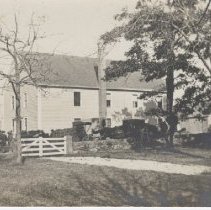
Hillside Farm Painting
Westport Historical Society
Westport, Massachusetts

Search Term Record

Metadata

Related Records

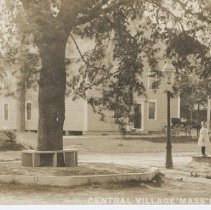
  1. 2000.205.001 - an account of the Macomber family of Central Village originally hand written by Marianna Macomber and typed by Margaret (Macomber) Douglas.This is a computer printout on archival paper. Marianna was born November 6, 1889, the youngest child of John Macomber 2nd and Esther Allen Macomber. Some family history of the Macombers and Allens Planting of the big tree in Central Village Farming activities: Rhode Island Red Hens, fruit trees Quaker Preferred simplicity and a lack of color Lydia and Olive Macomber, born deaf and dumb, educated at the American School for the Deaf in Hartford CT. Communication with Aunt Olive using a small slate Leonard Macomber married Esther Austin John Macomber was a teacher. Leonard Macomber died of diphtheria. He was included in "The History of Bristol County" Allen family history Ann Allen learned the trade of tailoress from Keziah Gifford. Story about George Gifford. Mary Gifford "the most highly respected woman in Westport", a minister in the Society of Friends Description of home: Milk room Johnnycakes Cured ham, molasses, sugar cookies and donuts. John Macomber married Esther Allen in 1874. Architecture was changing: "one of the new features they most desired in the new house were rooms high enough to stand up straight in every part. They achieved their desire and some later occupants found them a heating problem. They were all houses of 10 to 14 rooms for three people. The tendency then being for large houses with several rooms only intended for use on special occasions, bedrooms with beds made ready and immaculate, parlors all with drawn shades and all air tight against dust or a marauding fly." John Macomber was a teacher, Town Clerk, and became an undertaker. Marianna would recycle the casket catalogs, creating scrapbooks "with no feeling that they were unsuitable they are pasted besides suspenders and men's long underwear cut from some catalogue." John Macomber became Mass representative Andrew Borden stayed with them "I should think you would be afraid to have Andrew Borden at your house for he is cousin to Lizzie." My answer was, "Why should I be afraid of Andrew? He is nice to me." Measles. Passenger train from Fall River to New Bedford Alice insisted on driving up to The Narrows School Teachers Discipline Peddlars Stores Tramps Spring cleaning Town Meeting Clothing Stage coach May Baskets Blueberries

    Central Village Schools Poor Farm Railways Stores Farming

    Record Type: Archive

  2. Scrapbook
  3. Scrapbook
  4. 2004.170.018 - Sept. 13th 1699. WHS 2004.170.018 The Meeting House at Central Village The Friend's Society at Central Village is the outgrowth of the Quaker migration to Dartmouth begun soon after 1660. In the records of the Dartmouth Monthly Meeting is found under the date 9th month 13th, 1699, the following item:" It is agreed that our fourth day meeting is to kept at Acoakset one day at Stephen Willcocks, next at James Tripps, and so by turn continuing the ensuing winter." This is the first record we have concerning religious services being held in Westport. The two men, at whose home the meetings were held, belonged to families prominently connected with early history of this section. The meetings evidently grew as the population increased as many of the newcomers were Friends from Sandwich, Mass. or Portsmouth, R.I. In consequence of this growth, there was a meeting house planned in 1715. Concerning the building, the record makes the following statement on the 10th month 19th, 1715: "It is agreed that there shall be a meeting house built on the other side of Acoaxet river, 28 foot wide and 34 foot long, and 16 or 17 foot studs," and "the monthly meeting to defray the charge and it is concluded that the house above sd should be finished by the 15th day of the 8th month next." The land, upon which the meeting house was built, was bought from George Cadman and on July 19, 1716 the sum of "Three pound currant money" was paid said George Cadman for "One acre and a half and Sixteen rods situate lying & being within the Township of Dartmouth aforesaid and is the North west corner of that lot whereon his son-in-law William White now liveth and is by measure Sixteen rods in length and sixteen rods in Bredth, Bounded Southward & Eastward by his own land and Northward & Westward by undivided land." At the time the meeting house was planned and the land purchased, there was no road leading to the spot designated as a site for the meeting house, but in 1717 the town of Dartmouth formally laid out a road leading past this place. Soon after agreeing to build the meeting house, a committee was appointed to take a deed" to set Coakset meeting house upon". This committee was composed of Stephen Willcocks, William Wood, Henry Tucker, Thos. Taber Jun., and Joseph Taber. From a record made 11th month 21st, 1716/17, it is learned that the land was not paid for until after the building was completed, as it states." This meeting has concluded to make a subscription to pay 3L due for ye land whereon Coakset meeting house now stands." All the description of this first place of public worship in Westport to be found, is within covers of the old records, but this unfortunately is all too incomplete, and was made in 1782 when the building was to be renovated. This record states: "The committee to consult and consider with the women friends whether there ought not to be an alteration for the better in men's and women's seating themselves in our meeting for worship reported that it was their judgment that an alteration might be made for the better viz all both men and women to set below stairs when there is room and the way to accommodate it is for the men to fill all the seats to the west of the ally from the double door to the north door and the women to take all seats below to the east of the aforesaid ally and when the seats below are not sufficient for the people some men may go above stairs and some women make take seats in the little meeting house below which the whole is for the use of when meetings are held in the great house." The last few lines indicate that the structure was composed of a main building and an ell. This ell is again referred to in the records ten years later when a committee was appointed to "inspect into the circumstances of the winter meeting house at Acoaxet and see what repairing is necessary." This ell was used as the winter meeting, as the report of the committee just mentioned will show, which states, "those friends that were appointed to provide material for shingling the little part of the old meeting house reported that they have provided materials for the same ad seen the work accomplished and their bill of costs is four pounds and five pence." The Friends Meeting at Acoaxet belonged to the Dartmouth Monthly Meeting until March 1766. A committee was then chosen to set off boundaries of the new meeting and the record gives the boundaries of the new meeting and the record gives the boundaries of the new meeting as follows: "Beginning at the south easternmost corner of the Benjamin Wing Homestead Farm, from thence to Coaxet River as the line of the said Benjamin land goes. Thence southerly by said river to the sea. Again from said corner first mentioned thence northerly in the line between said village until comes to the Country road, thence on a straight line to the nearest part of the westernmost branch of the Noquochoke River thence by said branch of said river till it comes to Freetown line." The old meeting house all ready described stood until 1813, when the record dated 2nd month, 18th day states: " The committee to view and examine the old meeting house in order to ascertain whether it may be best to repair it or build a new one report in favor of building a new house to take down the high part of the house and let the low part stand to hold meetings in while the new house is in building - the new house to be forty five feet by thirty feet with gallerys with slides for the accommodation of the men's and women's meeting to be held separate much in the form meeting houses are generally built with a porch fourteen feet by ten - the Committee find that a new house of the above description can be got built for twelve hundred Dollars with working in what stuff that may be suitable for it out of that part taking down." The following month, so the record states, a building committee composed by Paul Cuffe, Ebenezer Baker, Prince Wing, Abner Potter, Joseph Tripp, George Brightman and Samuel Newitt(?) were chosen. In March 1814 the building was completed at the total cost of $1198, two dollars less, than the amount estimated. This building when complete was typical of the meeting houses of a century ago. Its walls were devoid of paint or ornamentation, its benches were cushionless, and its floors were sanded. It was heated by fireplaces and divided by a sliding partition. This building, which is the present meeting house, was greatly modernized in 1872, when the galleries, sliding partition, and fireplaces were removed. The interior was then painted and carpets, cushions, and stoves were used in refurnishing the meeting house

    Central Village Friend's Meeting House Quakers

    Record Type: Archive

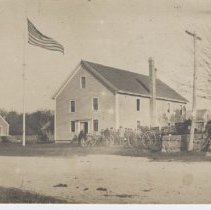
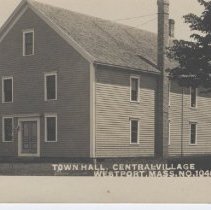
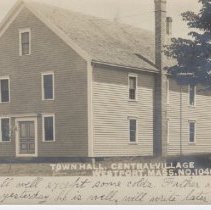
  5. 2005.081.135 - Old Town Hall with horses and carriages and house to the left.

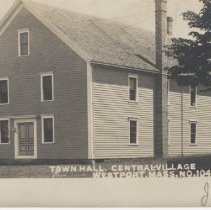
    Main Road Central Village Westport Town Hall

    Record Type: Photo
    Central  Village/Old Town Hall
  6. Town Hall Central Village
  7. Central Village-Old Town Hall
  8. Town Hall, Central Village
  9. Town Hall-Central Village
  10. Adamsville and Main Intersecti
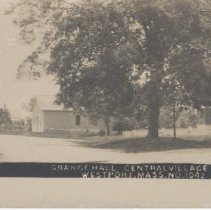
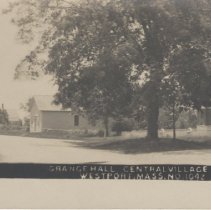
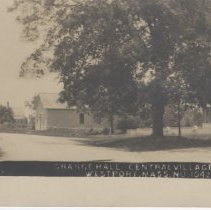
  11. Grange Hall
  12. Grange Hall
  13. Grange Hall
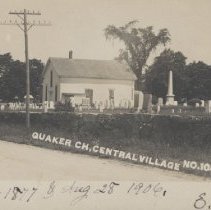
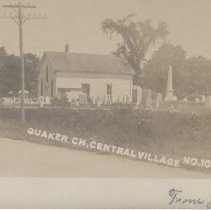
  14. Quaker Church
  15. Quaker Church

Thank You!

Confirmation Message Here....